
GOLD · ~$4,370–4,440/oz “A Second Straight Weekly Gain, Just as the Iran Ceasefire Hits Its Deadline”
WHAT HAPPENED. Gold opened the week firmly, extending the rally built since early August with a 2.4% weekly gain at Monday’s open and trading as high as $4,420–4,440 in early Asian hours before easing slightly. The metal is now up more than 95% over the past year and remains within striking distance of its January all-time high of $5,597.23.
WHY IT HAPPENED PRIMARY DRIVER (A RUN OF SOFT US DATA). Last week’s data flow reinforced the dovish shift that began with the July jobs report: July CPI and PPI both landed cooler than feared, July retail sales fell 0.6% against an expected 0.1% gain, and the University of Michigan’s consumer sentiment index dropped 8% in August. Markets now price roughly a 67% probability that the Fed holds rates in September up from below 50% just a month ago. China’s central bank added another ~20 tonnes to its gold reserves in July, extending its buying streak to a 21st consecutive month, reinforcing the structural floor even as short-term momentum is being driven by the US data surprise.
SECONDARY DRIVER (A CEASEFIRE ON THE CLOCK). The interim US-Iran ceasefire agreement is set to formally expire this week, with negotiations to end the conflict and reopen the Strait of Hormuz still deadlocked. Treasury Secretary Bessent has said Washington will impose “unprecedented economic measures” against Iran while maintaining its naval blockade, with further announcements expected in the coming days. Notably, long-dated Treasury yields have stayed elevated even as short-end pricing turns more dovish reflecting market concern, first flagged by Fed Chair Warsh himself, that a rate hike may not be the right tool to fight energy-driven inflation, and that the Fed may be underestimating the risk.
STRUCTURAL FLOOR & SCENARIOS. Central bank buying and a softening dollar continue to underpin the multi-year bull case.
- Bull case: the ceasefire lapses without renewal, oil spikes further, and Wednesday’s FOMC minutes plus Warsh’s Jackson Hole remarks confirm a cautious, data-dependent Fed gold pushes toward $4,500+.
- Bear case: a last-minute ceasefire extension is reached and Warsh strikes a hawkish tone at Jackson Hole, reviving September hike bets and pulling gold back toward $4,150–4,260.
- Main catalyst: the ceasefire deadline itself, Wednesday’s FOMC minutes, and Warsh’s Jackson Hole speech.

SILVER · ~$64.50–65.50/oz “Consolidating Last Week’s Breakout, Ratio Holding Near Its Average”
WHAT HAPPENED. Silver has held its ground after last week’s sharp payrolls-driven surge, trading around $65.45, essentially flat on the day as it consolidates the gains reclaimed the week before. The gold-silver ratio sits near 67:1, little changed and now close to its long-run historical average after the stretched 69:1 reading seen in late July.
WHY IT HAPPENED. Silver’s stability at elevated levels reflects the same soft-data backdrop supporting gold cooler CPI/PPI, weaker retail sales, and softer consumer sentiment all point toward a Fed that is unlikely to hike in September, removing a key headwind. With the ratio no longer stretched, silver’s move now more closely tracks gold’s own direction rather than offering a distinct catch-up trade.
INDUSTRIAL DEMAND & PHYSICAL DEFICIT. The sixth-consecutive-year physical deficit thesis remains fully intact and continues to provide a structural floor beneath the macro-driven price action.
- Bull case: the Iran ceasefire lapses and a dovish Fed narrative is reinforced at Jackson Hole, carrying silver toward $68–70.
- Bear case: a hawkish surprise from Warsh or a ceasefire extension reverses the dovish repricing, pulling silver back toward $60–61.
- Main catalyst: FOMC minutes, Jackson Hole, and any fresh Iran ceasefire headlines.

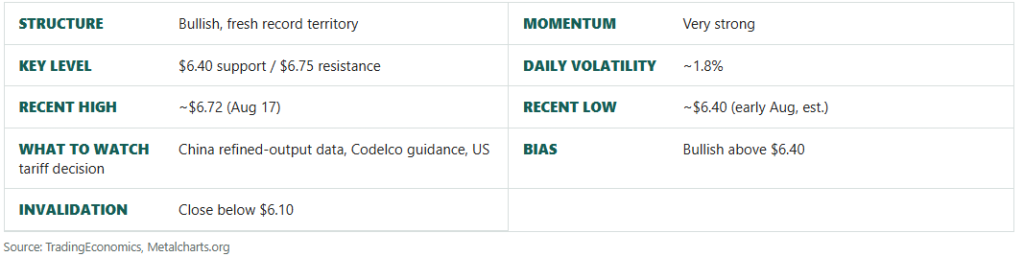
COPPER · ~$6.60–6.72/lb “A Second Consecutive Month of Falling Chinese Output Pushes Copper to Fresh Records”
WHAT HAPPENED. Copper jumped above $6.70/lb on Monday, moving toward fresh record territory, up nearly 5% over the past month and roughly 48% year-on-year. The metal has now outpaced every other asset in the complex on a trailing-month basis as a genuinely tight physical market collides with continued tariff-driven US stockpiling.
WHY IT HAPPENED — SUPPLY (PRIMARY DRIVER). China’s refined copper output is expected to decline for a second consecutive month in August, as persistent shortages of copper concentrate and other smelter feedstocks continue to weigh on operating rates. Compounding this, tighter domestic tax-invoice regulations have reduced the availability of VAT-compliant recycled copper, cutting off another key source of smelter feedstock. In Chile, state-owned Codelco reportedly expects production to decline this year on setbacks at its mines and development projects layering onto the DRC’s concentrate export ban and the ongoing El Teniente disruption flagged in prior editions. Traders also remain cautious over a potential US import tariff on copper, which continues to divert metal from international markets into US warehouses.
DEMAND (SECONDARY DRIVER). Power-grid upgrades and AI data-center buildout remain the unchanged structural demand driver, giving the current supply squeeze little room to be absorbed by slower demand growth.
- Bull case: China’s output decline extends into September and Codelco’s guidance disappoints further, pushing copper well past $6.72 into fresh record territory.
- Bear case: a formal US tariff decision disappoints or Chinese smelters restore feedstock access faster than expected, easing the current squeeze.
- Main catalyst: China’s August refined-output data, Codelco’s updated production guidance, and any formal tariff announcement.
PLATINUM · ~$1,750–1,790/oz “A Fourth Attempt at a Key Resistance Level”
WHAT HAPPENED. Platinum has continued to trade firmly, around $1,770/oz, extending the strong monthly move flagged in the prior edition. Technical commentary this week noted the metal is making its fourth attempt to hold above a key resistance level after three prior failed attempts with the second of those highs notably above the current and third attempts, a pattern some technicians read as a warning sign for near-term follow-through.
SUPPLY RISK (PRIMARY DRIVER). The structural case is unchanged: the World Platinum Investment Council continues to project a fourth consecutive annual supply deficit for 2026, with constrained South African mine supply and elevated energy costs the persistent headwinds to output. This remains a slower-moving, background driver relative to the sharper macro moves in gold, silver, and copper this week.
DEMAND RISK & LONG-TERM CATALYST. The continued shift toward electric vehicles remains a cloud over the demand outlook even against the tight-supply backdrop, while China’s expanding hydrogen fuel-cell fleet remains the structural long-term catalyst.
- Bull case: platinum finally breaks decisively above resistance as the broader precious-metals complex extends its rally into Jackson Hole.
- Bear case: the fourth attempt fails like the previous three, and platinum retraces back toward $1,650–1,700.
- Main catalyst: gold/silver direction around Jackson Hole and the FOMC minutes.

This report is for informational purposes only and does not constitute investment advice. All prices are approximate and subject to market conditions. · Pan Asia Market Intelligence · 17 August 2026