
GOLD · ~$4,300–4,365/oz “A Payrolls Contraction Undoes the Fed’s Hawkish Dissent in a Single Session”
WHAT HAPPENED. Gold has rallied sharply off its early-August base near $4,050, hitting a seven-week high above $4,360 and posting its best weekly gain since January. The move was triggered almost entirely by Friday, August 7’s July jobs report, which arrived far weaker than anyone expected and instantly overturned the hawkish narrative that had dominated since the FOMC’s split decision the week before.
WHY IT HAPPENED — PRIMARY DRIVER (A GENUINE LABOUR-MARKET CONTRACTION). Nonfarm payrolls fell by 23,000 in July an outright contraction against a consensus estimate of an 80,000–95,000 gain while May and June payrolls were revised down by a combined 103,000, dragging the trailing 12-month average pace of job creation to roughly 34,000 a month. The unemployment rate ticked down to 4.1%, but only because the labour-force participation rate fell to a level not seen in over five years. Average hourly earnings growth slowed to 3.2% year-on-year, the lowest since May 2021. September rate-hike odds collapsed to roughly 42%, down from 58% the day before, and the three hawkish FOMC dissenters from the July meeting suddenly looked far more isolated.
SECONDARY DRIVER (A STILL-UNRESOLVED HORMUZ STANDOFF). Hopes for a quick Strait of Hormuz reopening deal briefly raised when Treasury Secretary Bessent suggested an agreement could land “today or tomorrow” have since faded. Iran is reportedly seeking to exclude US and Israeli-linked vessels and impose transit fees on countries it deems hostile, while Washington is pushing for unrestricted transit and a full return to pre-war conditions leaving the two sides “seemingly far apart.” Houthi forces claimed an attack on Saudi Arabia’s Jazan refinery, and an ADNOC-operated tanker came under attack in the Strait over the weekend, keeping a geopolitical floor under gold even as oil itself has eased on hopes of eventual normalization.
STRUCTURAL FLOOR & SCENARIOS. One major global bank reiterated a forecast for gold to reach $5,000/oz in the first half of 2027, citing the same dynamic of a softer dollar and lower real yields now in play.
- Bull case: July CPI (due mid-week) comes in soft, cementing the dovish repricing, and gold pushes toward $4,400+.
- Bear case: a hot inflation print gives Fed Chair Warsh who the FT reports remains willing to hike in September if inflation stays elevated grounds to reassert a hawkish tone, pulling gold back toward $4,150–4,200.
- Main catalyst: July CPI data and any concrete movement (or further breakdown) in the Iran-Oman Hormuz talks.

SILVER · ~$60–64/oz “A 4% Single-Day Surge Compresses the Ratio Back Toward Its Average”
WHAT HAPPENED. Silver ripped higher alongside gold on Friday’s jobs shock, jumping over 4% in a single session to $64.10 a six-week high before consolidating into the new week. The gold-silver ratio compressed to roughly 67:1 from close to 69:1 the week before, rewarding investors who had accumulated the metal at the wider ratio.
WHY IT HAPPENED. As the highest-beta precious metal, silver amplified the dovish repricing from the payrolls miss even more sharply than gold: the same drop in the dollar to a two-week low and the pullback in Treasury yields that lifted gold gave silver an extra kick, consistent with the pattern seen through this entire macro cycle. The move also validates the read flagged in the prior edition that a stretched ratio near 69:1 has historically preceded periods of silver catching up rather than falling further behind.
INDUSTRIAL DEMAND & PHYSICAL DEFICIT. The structural sixth-consecutive-year deficit thesis remains fully intact and, if anything, is now reinforcing the macro-driven rally rather than competing with it.
- Bull case: a soft CPI print this week extends the dovish repricing and the ratio continues compressing toward its long-run average, taking silver toward $68+.
- Bear case: a hot CPI print revives hike-path pricing broadly and silver’s gains partially unwind back toward $58–59.
- Main catalyst: July CPI data and follow-through in the gold-silver ratio.

COPPER · ~$6.55–6.70/lb “Fresh Record Highs as Congo’s Export Ban Piles Onto an Already-Tight Market”
WHAT HAPPENED. Copper broke to fresh record highs above $6.70/lb on Friday, August 7, before easing modestly to around $6.57–6.59/lb over the weekend into Monday, August 10. The metal is up more than 8.5% over the past month and roughly 47% year-on-year, extending a rally that has now outpaced even gold and silver’s payrolls-driven surge.
WHY IT HAPPENED — SUPPLY (PRIMARY DRIVER). Two major new supply shocks landed on top of the existing tariff-driven distortion: the Democratic Republic of Congo banned exports of copper concentrates, part of a broader trend of resource-rich nations moving to retain more value through domestic refining, and operations at part of Codelco’s flagship El Teniente mine in Chile could remain suspended for up to two years following a geotechnical incident, compounding losses across an industry already pushing deeper underground into more difficult ore bodies. On top of this, more than 200,000 tons of copper arrived at US ports in July the largest monthly inflow in over a decade as buyers continued to front-run a possible tariff announcement, while analysts flagged a growing risk of a short-term squeeze on the LME given scarce on-warrant inventories and falling visible stockpiles in China.
DEMAND (SECONDARY DRIVER). Power-grid upgrades and AI data-center expansion continue to underpin the structural demand case, unaffected by the current supply shocks.
- Bull case: El Teniente’s suspension is confirmed at the longer end of its range and the DRC ban proves durable, pushing copper toward Goldman’s flagged $13,000/tonne-plus targets.
- Bear case: a formal tariff decision disappoints expectations, unwinding some of the US stockpiling premium.
- Main catalyst: further Codelco guidance on El Teniente, DRC policy follow-through, and any formal update on the US refined-copper tariff.

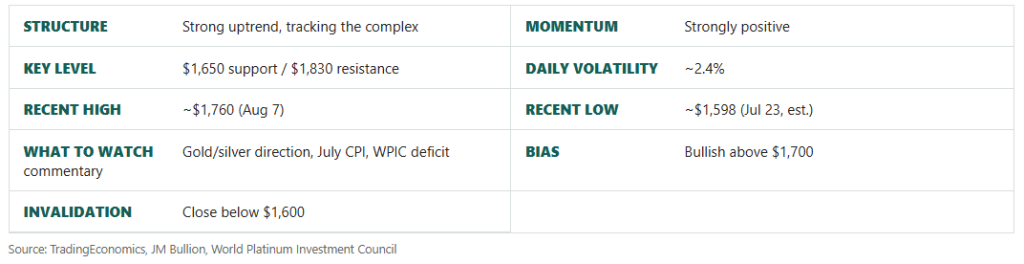
PLATINUM · ~$1,675–1,760/oz “Riding the Broader Metals Wave, Up More Than 10% on the Month”
WHAT HAPPENED. Platinum has climbed alongside the rest of the complex, reaching $1,759.60/oz on August 7 up 10.82% over the past month its best stretch since the correction that followed June’s late-month peak. The move was helped both by the broader payrolls-driven dovish repricing and by the brief (if since-faded) optimism around a Hormuz reopening deal earlier in the week.
SUPPLY RISK (PRIMARY DRIVER). The structural case is unchanged: the World Platinum Investment Council continues to project a fourth consecutive annual supply deficit for 2026, with constrained South African mine supply and elevated energy costs the persistent headwinds to output. That backdrop, largely dormant through the macro-dominated weeks of July, is now working in the same direction as the broader precious-metals rally rather than against it.
DEMAND RISK & LONG-TERM CATALYST. The continued shift toward electric vehicles remains a cloud over the demand outlook even against the tight-supply backdrop, while China’s expanding hydrogen fuel-cell fleet remains the structural long-term catalyst.
- Bull case: the payrolls-driven rally extends into CPI week and platinum’s high beta carries it toward $1,830+.
- Bear case: a hot CPI print reverses the dovish repricing across the complex, pulling platinum back toward $1,650.
- Main catalyst: gold/silver direction into and after July CPI, plus any fresh WPIC commentary.
This report is for informational purposes only and does not constitute investment advice. All prices are approximate and subject to market conditions. · Pan Asia Market Intelligence · 10 August 2026